

Camino de Santiago

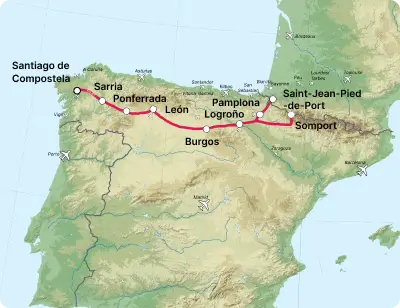
The French Way stands as the first of the Jacobean routes to Santiago. From Roncesvalles or St. Jean de Pied de Port and to Santiago de Compostela, the French Way travels almost 900 kilometers (560 Miles) full of experiences. Two countries, several languages and countless cultural and cultural manifestations will come your way
Mountain landscapes, valleys and moors are just a few examples of the wonders of this route. Beech, oak, vineyards and meadows offer hundreds of shades. The art in stone appears in every corner, not in vain you can follow the trail of the Romanesque Camino de Santiago. You are expected by World Heritage cities such as Burgos, León or Santiago, with Gothic, Renaissance, etc. buildings.
El Camino is a meeting point in the large and small squares of the villages that you will visit; you will visit big cities but also small villages and villages, and this is precisely "the magic of the Way": to be able to go through the daily life that houses

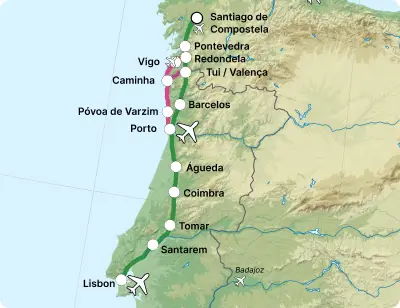
The Portuguese Way becomes important from the 12th century onwards, fostering economic and cultural exchanges between Spain and Portugal. Before arriving at Santiago de Compostela, this itinerary passes through the town of Padrón where the boat that carried the body of the Apostle Santiago arrived, that came from Palestine through the Portuguese coast.
The Portuguese Way is the second Way of St. James most wanted after the French Way, and there are many reasons: it combines two countries and with them appears richness in their languages, their history, their architecture or their cuisine.
From Oporto to Santiago, you can follow the interior variant, discovering places like Ponte de Lima, Tui or the monumental area of Pontevedra. The interior variant joins with the coast in Redondela, reason why from this town and until Santiago de Compostela, only exists a Portuguese Way.
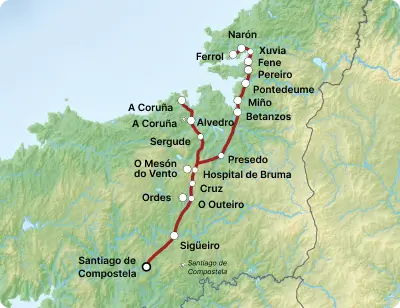
We propose a path by the sea, starting in the modernist neighborhood of A Magdalena in Ferrol. This city is one of the starting points of the English Way, although you can also start in A Coruña, if you want to get the Compostela.

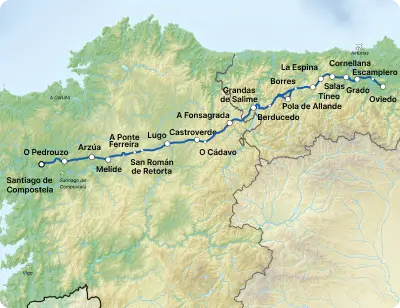
The Primitivo Way is the original Way of Santiago, is the first of which have references of a pilgrimage to Santiago de Compostela. For the itinerary that today we know the King Alfonso II, pilgrimage from Oviedo. Today the Road to Santiago Primitivo stands out for being declared by UNESCO Unesco Heritage of Humanity along the roads of the Coast, Basque Interior and Liébana. It crosses unique landscapes of the interior of Asturias and Galicia.
For many this is an unknown road, little traveled. It is precisely this feature that makes it attractive. The green of this road is almost "insulting", will accompany you from the exit of Oviedo to the gates of Santiago.

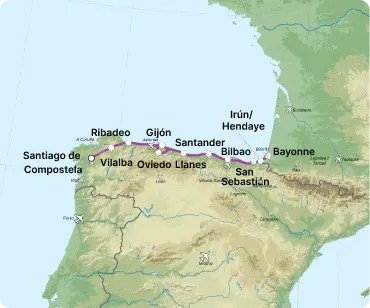
The North Way, recently declared by Unesco World Heritage Site, is the Camino de Santiago that runs through the Bay of Biscay to Galicia, where, at the height of Ribadeo, it enters the interior of the provinces of Lugo and A Coruña.
Along its stretch along the Cantabrian Sea, you will find colorful harbors, beaches, cliffs and the landscape of small estuaries. The elegant San Sebastian, the renewed bustle of Bilbao, Santander with its Sardinero or the immense San Lorenzo beach in Gijón are the most urban parts of this itinerary. Already in Galicia awaits a succession of valleys and mountains, full of mysticism and legends.
The North Road comes from France, and enters Spain by Irún. From this point it follows the coast although in essence it is not always advanced next to it, since the North Road encompasses all kinds of landscapes. In this way, sea and mountains shake hands.

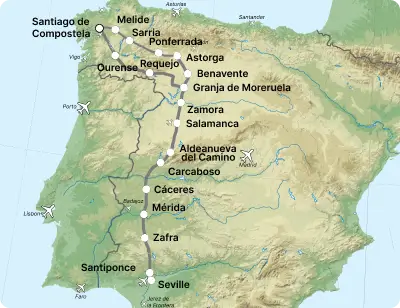
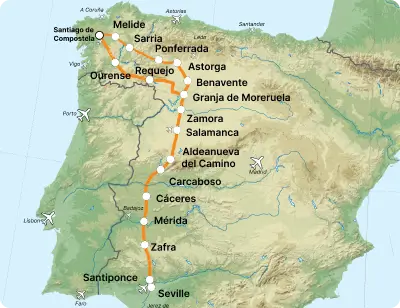
The Via de la Plata owes its name to an ancient Roman road that linked the city of Merida "Émerita Augusta" with Astorga "Asturica Augusta". Currently, the Vía de la Plata is a wonderful touristic route that crosses Spain from the south to the north, showing us an endless number of landscapes. Probably the most contrasting road, since part of a Mediterranean environment, arriving many kilometers later to the green and humid Galicia. It is a variant of the Camino with several places that are a World Heritage Site such as Merida, Cáceres or Salamanca.
As regards its relationship with the Camino de Santiago, this itinerary begins in Seville and from south to north, crossing villages dedicated to bullfighting, wine or livestock, and also runs through the cities of Mérida, Cáceres or Salamanca. This road is called the Mozarabic Way which through the province of Ourense enters Galician, after overtaking the Alto de Padornelo

The Camino de Santiago Fisterra - Muxía will take you to know Fisterra, located on the Costa da Morte, in the province of A Coruña and 99 km from Santiago de Compostela.
Formerly it was believed that Cape Fisterra was the End of the World, that is why many Pilgrims, after having embraced the Apostle Santiago, continued their journey to the Atlantic Ocean, so that they could see the end of the world complementing this path.
How to Prepare for the Trip
1. Do I need physical preparation prior to the trip?
Although this trip is suitable for for any person with normal physical condition, we recommend training for a few weeks prior to your trip, especially for those not accustomed to walking or biking for longer distances. We highly recommend taking very comfortable walking/biking shoes that have been previously broken in, so as to avoid blisters, bruises and discomfort.
2. What items do I need to complete the Camino?
We recommend a light, comfortable weatherproof backpack which you will carry on every stage and that must contain indispensable items for your walk (water bottle, personal documents, a cell phone, snacks, etc. We recommend broken in walking shoes/boots with which you are used to waking, light comfortable clothing, rain gear, a cap or hat, sun screen and sun glasses. During nighttime, warmer clothing such as a sweater or jacket are necessary. A walking stick can help you walk in a more relaxed manner during the more challenging stages. A photo camera and a notebook are also very recommendable. You should always start you day with a hearty breakfast and always take some snacks with you every day such as fruit, dried fruit, energy bar or chocolate. The most important is a full water bottle.
The Camino and its Services
1. Where does the Camino take place?
The route will take you through many rural country roads and paths as well as local roads with light traffic. On occasions the camino will take you through roads near larger towns and villages with higher density of traffic.
2. How is the grade?
There are no major grade changes. The beautiful Galician countryside is filled with mostly mild inclines and declines, valleys and mountains, rivers and streams. It can be said that the Way is relatively easy, it is always very beautiful. The major difficulty could be the total distance covered to complete your route, especially in the colder months (Nov-Feb) or warmer months (Jul-Aug).
3. Is the Camino dangerous?
Absolutely not. The Camino does not present any danger whatsoever. However, it is recommended that you take the normal safety precautions as you would anywhere else.
4. Is the Camino well outlined/marked?
You will see many markers along the Camino, they are well positioned and clear throughout the route. Look for the scallop shell which is the symbol of the Camino de Santiago. We also provide you with our travelers notebook in case you have any doubts throughout your journey at any given time. It is very rare to get lost. If you do, there are many places to stop and ask other travelers or the locals for directions.
5. What services are available along the Camino?
You will find many small hamlets, towns and villages along the Way where you will find all sorts of services: pharmacies, medical services, supermarkets, restaurants, cafes and local tourist offices. In some villages, during the summer you can even swim in the local pool or in the nearby river or creek. You can also find massage services after a long days walk..
6. How are the dinners?
If you have booked your itinerary with dinner included, these will take place either at your hotel or in a local restaurant nearby the hotel. All dinners include water and wine. They consist of menus containing three plates (appetizer, main dish and dessert). Coffee and tea is normally not included. In some cases the menu will be a specialty menu with a hearty variety of tapas and local specialties of the region of Galicia.
7. Is lunch available along the Way?
There are many options available for you to have lunch along the Camino: from sandwiches to drinks to sit-down meals at restaurants or pic-nics on the side of the road, etc. Your travelers notebook contains recommendations for lunch.
When on the Camino
1. What is the starting time for each stage?
We recommend starting early, after enjoying a hearty breakfast, at about 8:30am. The majority of hotels and manor houses offer breakfast service from very early in the morning. In any case you can start your walk according to your wishes. You should normally finalize your stage at or about normal lunch time – this way you can relax and enjoy the rest of the day at your leisure and discover these fantastic towns and villages.
2. How does the luggage transportation work?
You can only take 1 piece of luggage (max 44 lbs). We will transport your luggage every day from your originating town to the next town while you travel. Your luggage will be waiting for you at your next hotel. You will be provided with special luggage tags for your luggage with your documentation. Please make sure that your luggage is closed and properly locked.
3. What happens if I’m on the Camino and no longer able to continue?
If you can no longer continue your walk or bicycle, we provide you with support telephone numbers that you may call and we will send a car in a short time to pick you up and take you to the next location.
4. Can I drink from the water fountains found along the Camino?
Although the water from the fountains along the Camino are usually safe, we do not recommend you drink from them and highly recommend drinking only bottled mineral water.
Frequent Asked Questions
1. How do I arrive to the starting point?
Petrabax can help you arrange a transportation from the closest airport to your starting point. We can also arrange train tickets through Renfe (Spanish Railways) from most Spanish cities. Contact Petrabax for additional information about the best way to arrive to your starting point.
2. What can I expect from this trip?
You will live an unforgettable experience, away from the bustle of everyday life. This is a trip that you can do in total liberty, on foot or by bicycle, and at your own pace as this is not a race. Your luggage (maximum 1 piece, 44 lbs) will be carried for you from one destination to the next. We provide you with all the necessary expert advice, information and documentation that you require to complete your journey safely: local maps detailing your route, vouchers for your lodgings, tags for your luggage and a travelers notebook for your trip with descriptions on each daily walking or biking route.
3. What is the “Compostela”
The “Compostela” is a certificate of accomplishment given to pilgrims that have completed the Camino de Santiago upon presentation of your stamped "Credendial" or Pilgrims Passport. In order to receive the “Compostela” you must complete the last 100 km walking or 200 km cycling. You obtain the “Compostela” at the Office of the Pilgrim located a few meters from the Platerias façade of the Santiago Cathedral.
4. Where do I obtain a Pilgrims Passport?
he "Credencial" or Pilgrims Passport will be provided to you by Petrabax in Spain at the beginning of your trip. It is part of the travel materials and insurance informaion provided upon arrival to your starting point.
5. Where do I receive my trip documentation?
You will receive most of your documentation prior to your departure so that you can review it and prepare for your Camino. Other documentation will be delivered at your first hotel.
6. When can I take this trip?
You can take this trip starting any day of the year. The Camino offers diverse countryside and conditions depend on the season and time of year. Consult the weather of Galicia before arranging your trip. Rainy season is from November through February. March through June and September through October are optimum months for the Camino. The summer months of July and August can be somewhat more challenging due to the warmer weather.
7. What is the profile of the traveler on this trip?
This trip is suitable to any person who enjoys a normal physical condition. We do however highly recommend that you do some training, especially those persons who are not accustomed to walking or cycling for longer periods of time.
8. Can I travel with children?
Yes, older children are welcome on the trip as long as they are energetic and accustomed to walking long distances on successive days.
Petrabax benefits:

Selected Accommodations

Energizing Breakfasts

Luggage Transportation

Medical Insurance

24/7 Local Assistance

Pilgrim Passport

Kit tailored for your journey
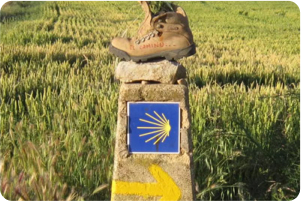
"Camino de Santiago" or The Way of St. James has existed for over a thousand years. Legend says that St. James's remains were carried by boat from Jerusalem to northern Spain where he was buried on the site of what is now the city of Santiago de Compostela. Today thousands of travelers set out each year to make their way to Santiago. Most travel by foot, some by bicycle.
In addition to people undertaking a religious pilgrimage, the majority are travelers and hikers who walk the route for non-religious reasons: travel, sport. Many consider the experience a spiritual adventure or retreat to remove themselves from the bustle of modern life.
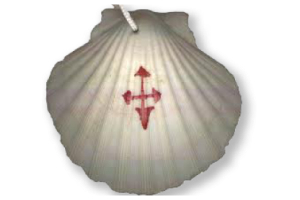
Symbols of The Camino De Santiago
The scallop shell, has long been the symbol of the Camino de Santiago. It is found along each route on markers and posts along the way guiding the pilgrim towards Santiago
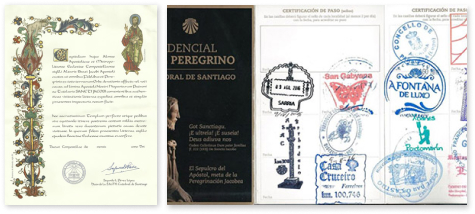
Credential or Pilgrim's Passport
Most pilgrims carry a “Credencial“, or pilgrims passport which is stamped at each town where the pilgrim has stayed. It serves as proof that the journey is accomplished according to an official route.
The stamped "Credencial" is also necessary if you want to obtain a "Compostela": a certificate of accomplishment given to pilgrims on completing the Way. To earn the "Compostela" one needs to walk a minimum of 100 km or cycle at least 200 km
Petrabax
Petrabax is also a leader in Spanish language escorted tours of Europe, Middle East and the Orient.


 Test
Test